2016
Bioinformatics · LIFE Hackathon
A Python/TensorFlow research prototype. Second place as a team.
Research prototype developer
The challenge
Automatically identify domains in protein spatial-structure data.
What I built
- Quickly learned a new stack.
- Proposed treating a contact map as a visual structure.
- Built a prototype and visualization.
Results
- The team took second place. (2nd place)
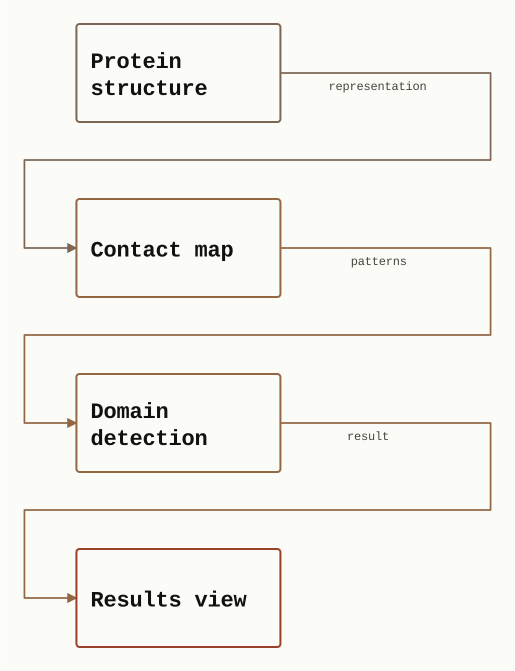
Components & connections
Source data
- Protein structureProtein spatial structure data.
Research prototype
- Contact mapA two-dimensional representation of the spatial problem.
- Domain detectionTesting the hypothesis through visual pattern recognition.
Experiment output
- Results viewA visual representation of the research result.
- Protein structure→Contact maprepresentation
- Contact map→Domain detectionpatterns
- Domain detection→Results viewresult
Engineering takeaway
Context
A team LIFE Hackathon project on clustering protein domains.
- Two days to build a team research prototype.
Approach
Translated an unfamiliar domain problem into a clear visual model and tested the hypothesis in code.
- Converted the spatial problem into a two-dimensional representation suitable for pattern recognition.
Lessons
- Learning a new domain becomes faster when the problem has a visual representation.
Stack
- Python
- TensorFlow
- Visualization