2025 — 2026
AI nutrition tracker
Backend architecture and AI features for a food diary.
Backend architect
The challenge
Users needed a quick way to log meals and receive useful context without complicated manual input.
What I built
- Designed the backend/API and the diary’s domain model.
- Worked with LLMs, knowledge models and vector search.
- Supported integration with the mobile application.
- Tested individual features through a Telegram prototype.
- Actively used coding agents during development.
Results
- Built a working backend foundation for AI-assisted nutrition tracking.
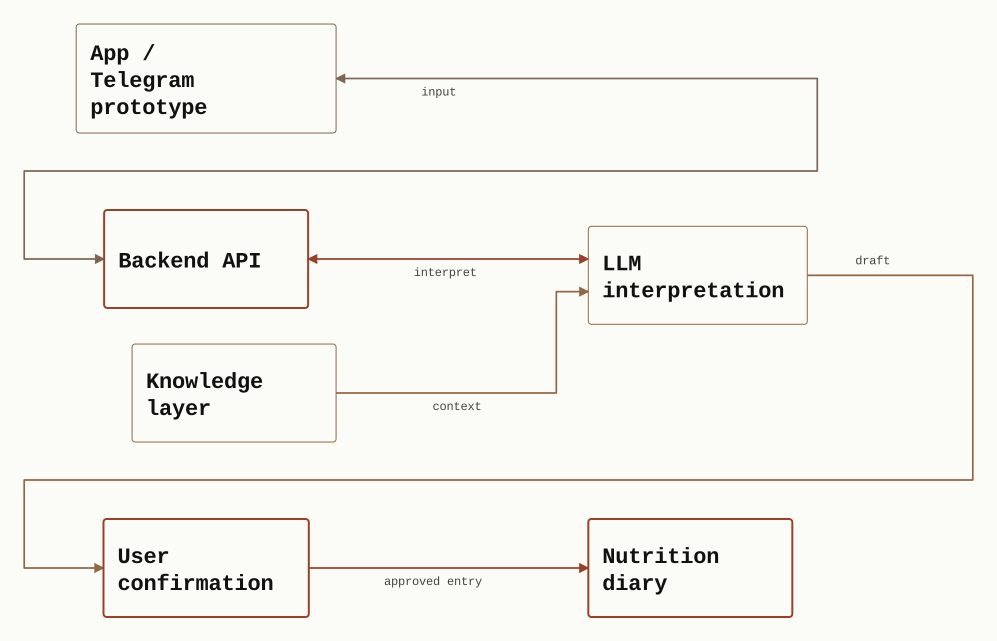
Components & connections
Food Input
- App / Telegram prototypeText, voice and image input.
Food Ai
- LLM interpretationInitial interpretation of meal input.
- Knowledge layerDomain knowledge and retrieval.
Food Domain
- Backend APIProfile and diary use cases.
- User confirmationReview and edit before saving.
- Nutrition diaryStructured meal history.
- App / Telegram prototype↔Backend APIinput
- Backend API↔LLM interpretationinterpret
- Knowledge layer→LLM interpretationcontext
- LLM interpretation→User confirmationdraft
- User confirmation→Nutrition diaryapproved entry
Engineering takeaway
Context
A food diary application with AI-assisted input.
- Users must be able to edit recognized data.
Approach
Connected AI-assisted input to the diary’s domain model and application API.
- Separated recognition and interpretation from the user’s confirmed entry.
- Kept results editable so an AI estimate would not be treated as an established fact.
Lessons
- AI-assisted input must leave users in control of structured data.
- The domain model benefits from being separate from a particular communication channel.
Stack
- Backend API
- LLM
- Knowledge base
- Vector concepts
- Telegram prototype